Tuesday, 12 March 2019

The ACCU's Overload magazine

ACCU is an organisation for programmers. Its original focus was C and C++, but now members use a variety of languages, talk about testing and process and how to keep learning. ACCU holds an annual conference in the UK, attended by people from around the world. There's even a YouTube channel of recorded talks from this.

As a member you get a discount for the conference, can volunteer to do book reviews, can participate in study groups, though these have been quiet lately, and get two magazines; the CVu members' magazine and Overload, which is open to anyone. There are also several local groups if you want to come along and meet us.

I've been a member for several years now. It's been a great networking opportunity and I have learn so much from other members. I love the magazines, and by starting to write for them myself, I stepped up my game. I began by writing book reviews, then tried some of the Student Code Critiques in CVu. Eventually, I wrote an Overload article, pulling together a discussion on the accu-general mailing list about floating point numbers.

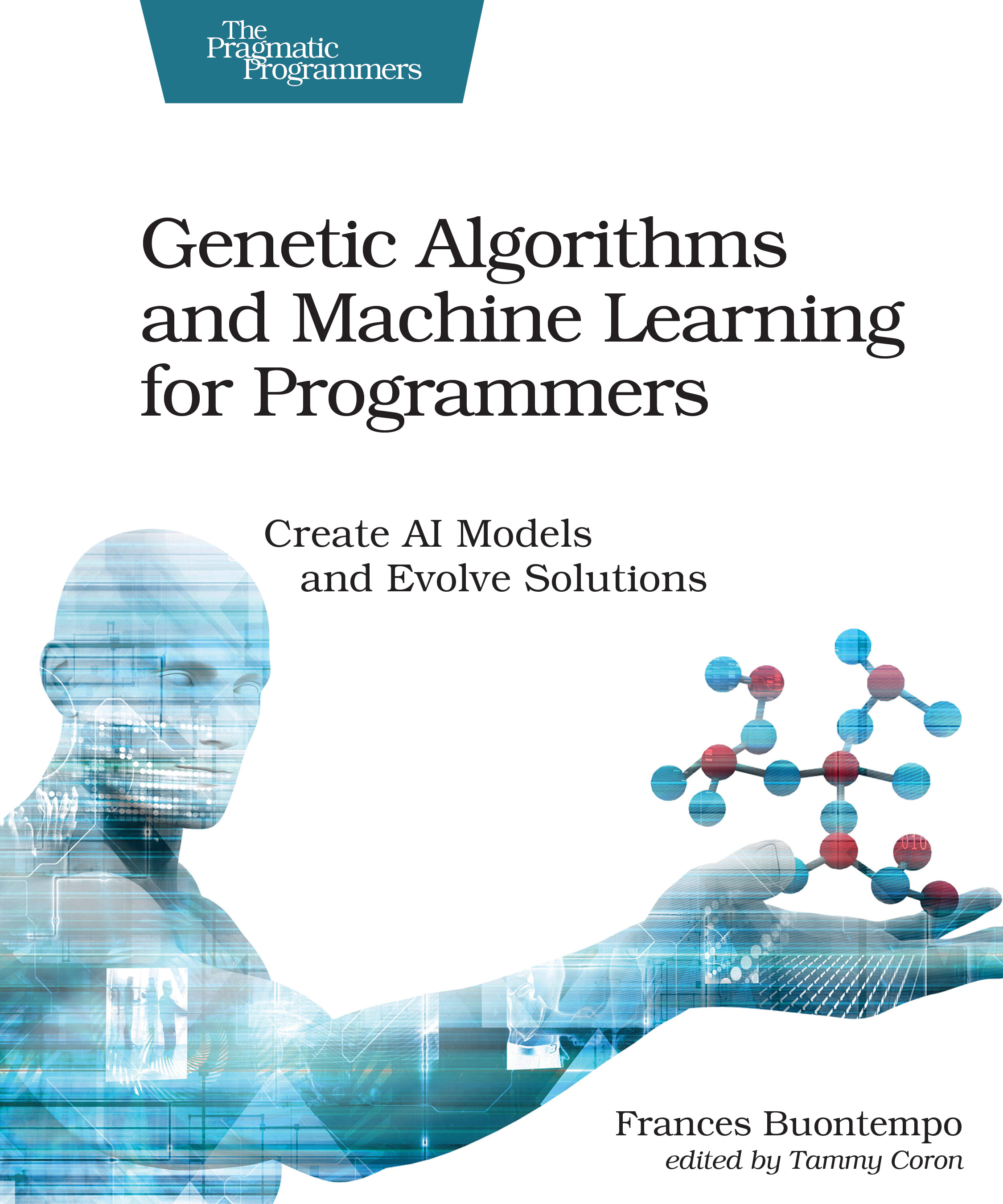
I took on the role of Overload editor in 2012. We welcome articles from non-members as well as members. They are peer reviewed, meaning the author gets feedback, questions and suggestions. A surprisingly high number of writers have gone on to write books, myself included. (I mentioned I wrote a book about genetic algorithms and machine learning, yes?)

If you have an article you'd like to get published, let me know. We do accept existing blog posts, but the review team might well ask for slight improvements. There are some submission instructions here.

We welcome established writers as well as new writers. If you've never written an article, give it a go. You can learn a lot by trying to write something up. For example, as you try to explain something you may find gaps in your knowledge and understanding. Questions and suggestions from the review team will make your article better.

I love the ACCU and am looking forward to this year's conference, in just under a month. If you can't make the conference, find a local group, or consider joining the organisation. Or submit an article for Overload. Get involved.


Tuesday, 26 February 2019

Code your way out of a paper bag

I attended nor(DEV):con, a tech conference in Norwich, last week. I gave a 45 minute talk which I called "Code your way out of a paper bag". A majority of my recent talks involve getting out of, and once into, a paper bag. I've used this as a vehicle to demonstrate some machine learning, AI and other algorithms.

I interviewed a candidate for a role a while ago, and the other interviewer commented the interviewee couldn't code their way out of a paper bag afterwards. Jeff Atwood, the co-founder of Stack Overflow, has made similar comments:

We're tired of talking to candidates who can't program their way out of a paper bag.

It's a shorthand way for saying people can't do something simple. First, programming isn't always simple. Second, how do you prove you can code your way out of a paper bag?

Use Genetic Algorithms

You could do something straightforward, like make a line zoom out of a paper bag, provided you have a way to draw things.


Alternatively, you could do something more complicated. I used genetic algorithms. If you fire a cannon ball, choosing the angle and initial velocity upfront, it may, or may not end up outside a paper bag, provided you use a tiny, virtual cannon, placed at the bottom of a paper bag. The cannon balls might just fire through the bag, but perhaps you can get them to go over the side if you choose the right numbers. There's a free excerpt from my book here talking this through.

Now, you could guess a few (angle, velocity) pairs and see what happens.  I got three people in the audience to do this. You could then swap the angle and velocity of the better tries, and maybe change one or both of the numbers slightly. This covers the essence of how genetic algorithms work. The swap is called crossover, drawing on the idea of chromosomes recombining when living organisms breed. The slight tweak is called mutation, and draws on the idea of random fluctuations in DNA . Darwin's evolution says these random changes give rise to new species. The fitter ones survive. All you then need is a function to decide how fit a solution is, often called a fitness function. Start with some random pairs, select some fitter pairs, use crossover and mutation for a while. In the end, the attempts might get better.

Over-engineered?


You could argue my approach is somewhat over-engineered. You'd be right. However, it's a nice self-contained example to demonstrate gentic algorithms. It was filmed, so will be up online soon. I'm not sure how clear the audience coming out with their attempts will be on film. Hopefully enough for you to get the idea.

How do you   out of a paper bag? Tell twitter, or tell me.

Have a look at my book too.


Wednesday, 6 February 2019

CppOnSea 2019

Phil Nash organised a new conference, CppOnSea, this year. I was lucky enough to be accepted to speak, so attended to two conference days, but not the workshops.


There were three tracks, along with a beginners track, run by Tristan Brindle, who organises the C++ London Uni, which is a great resource for people who want to learn C++. I'll do a brief write-up of the talks I attended.


The opening keynote was by Kate Gregory, called "Oh The Humanity!" She made us think about the words we use. For example, Foo and Bar trace back to military usage, hinting at people putting their lives on the line. Perhaps we need better names for our variable and functions. We are not fighting a war. What about one letter variable names? 'k. Nuff said. What about errorMessage? If you call the helpMessage instead, how does that affect your thinking?
Kate was also talking about trying to keep the code base friendly, to increase confidence:


I went to see Kevlin Henney next. I have no idea how to summarise this. He covered so many thing. What does structured programming really mean? By looking back to various uses and abuses of goto, By highlighting the structure in various code snippets, he was emphasising some styles make the structure and intent easier to see.

I saw Andreas Fertig next. Inspired by Matthew CompilerExplorer's Godbolt, he has created https://cppinsights.io/. Try it out. It unwraps some of the syntactic sugar, so you can see what the compiler has created for, say, a range based for loop. This can remind you where you might be creating temporaries or have references instead of copies or vice versa, without dropping down into assembly. Do you know the full horror of what might be going on inside a Singleton?
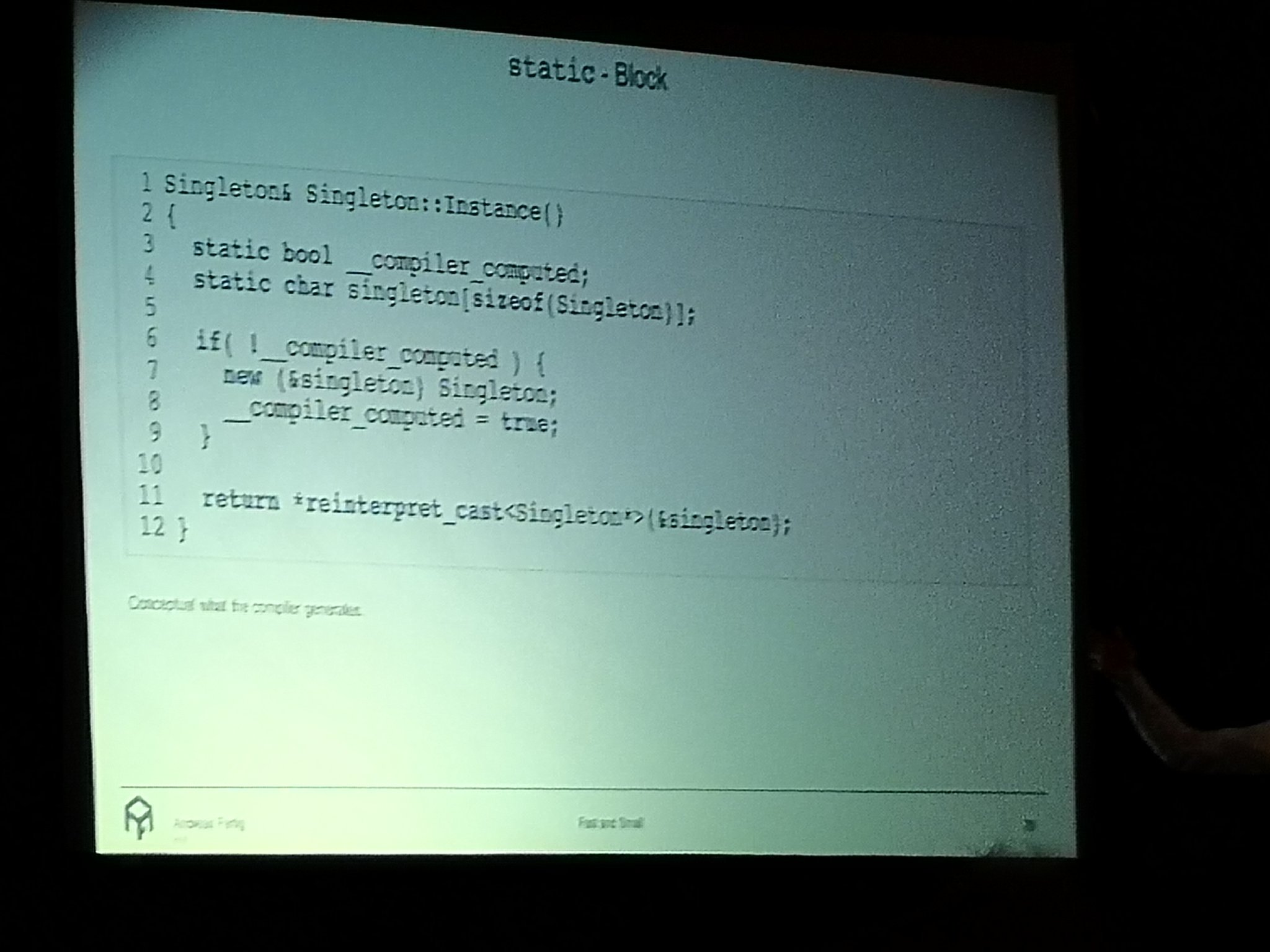
This led to an aside about statics and the double checked locking pattern. His headline point was the spirit of C++ is "you pay only for what you use", so be clear about what you are using. The point isn't that the new language features are expensive. They are often cheaper than old skool ways of going things. Just try to be clear about what's going on under the hood. Play with the insights tool.

Next up, I saw Barney Dellar, talking about strong types in C++. His slides are probably clear enough by themselves, since they have thorough speaker notes. My main note to myself says "MIB: mishap investigation board", which amused me. He was talking about the trouble that can happen if you have doubles, or similar, for all your types, like mass and force:

double CalculateForce(double mass);

It's really easy to use the wrong units or send things in in the wrong order. By creating different types, known as strong types, you can get the compiler to stop you making mistakes. Use a template with tags, you can write clear code avoiding these mistakes.

Next up was a plenary talk by Patricia Aas on Deconstructing Privilege. She's given the talk before, so you'll be able to find the slides or previous versions on YouTube. Her take is that privilege is about things that haven't happened to you. Many people get defensive if you say they have been privileged,  but this way of framing the issue gives a great perspective. Loads of people turned up and listened. Maybe surprising for a serious geek C++ conference, but the presence of https://www.includecpp.org/ ensured there were many like minded people around. If you are privileged, listen and try to help. And be careful asking intrusive questions if you meet someone different to you.

After quite a heavy, but great talk, I was "in charge" of the lightning talks. Eleven people got slots. More volunteered, but there wasn't time for every one:

Simon Brand; C++ Catastrophes: A Poem.
Odin Holmes; volatile none of the things
Paul Williams; std::pmr
Heiko Frederik Bloch; the finer points of parameter packs
Barney Dellar;imposter syndrome or mob programming
Matt Godbolt; "words of power"
Kevlin Henney; list
Neils Dekker; noexcept considered harmful???
Patricia Aas; C++ is like JavaScript
Louise Brown; The Research Software Engineer - A Growing Career Path in Academia
Denis Yaroshevskiy; A good usecase for if constexpr


My heartfelt thanks to Jim from http://digital-medium.co.uk and Kevlin "obi wan kenobi" Henney for helping me switch between powerpoint, power point in presenter mode and the pdfs, and getting them to show on the main screen and my laptop. No body knows what was happening with the screen on the stage for the speaker. If you ever attend a conference, do volunteer to give a lightning talk. Sorry to the people we didn't have time for.

Day one done. Day two begun.First up, for me, after missing my own talk pitch, was Nico Josuttis. Don't forget his leanpub C++17 book. It's still growing. He talked about a variety of C++17 features. The standout point for me was the mess you can get into with initialisation. He's using {} everywhere, near enough. Like

for (int i{0}; i<n; ++i)
{
}


Adding an equals can end up doing horrible things.

Much as I wanted to go see Simon Brand, Vittorio Romeo and Hana Dusikova (with slide progression by Matt Godbolt) next, I had a talk to do myself. I managed to diffuse my way out of a paper bag, while reminding us why C's rand is terrible, how useful property based testing can be, using some very simple mathematics: adding up and multiplying. This was based on a chapter of my book, and you can download the source code from that page if you want, even if you don't buy the book. I used the SFML to draw the diffusing green blobs. Sorry for not putting up a list of resources near the end.

I attempted to go to Guy Davidson's Linear algebra talk next, but the room was packed and I was a bit late. I heard great things about this. In particular, how important it is to design a good interface if you are making libraries.

My final choice was Clare Macrae's "Quickly testing legacy code". This was my unexpected hidden gem of the conference. She talked about approval testing. This compares a generated file to a gold standard file  and bolts straight into googletest or Catch. It's available for several other languages. It generates the file on your first run, allowing you to get almost anything, provided it writes out a file you can compare, under test. Which then means you can start writing unit tests, if you need to change the code a bit. Changing legacy code to get it under test, without a safety hardness is dangerous. This keeps you safer. Her world involves Qt and chemical molecules visualisations. These can be saved as pngs, so she can check she hasn't broken anything. She showed how you can bolt in custom comparators, so it doesn't complain about different generated dates and does a closer than the human eye could notice RGB difference. Her code samples from the talk are here.  I've not seen this as a formal framework before. Her slides were really clear and she explained what she was up to step by step. Subsequently twitter has been talking about this a fair bit, including adding support for Python3.

Matt "Compiler Explorer" Godbolt gave the closing keynote. Apparently, Matt is the first person Phil Nash has met who's first conference talk was a keynote. 


If you've not encountered the compiler explorer before, try it out. You can chose which compiler you want to point your C++ code at and see what it generates. You need a little knowledge of the "poetry" it generates. More lines doesn't mean slower code. His tl;dr; message was many people spread rumours about what's slow, for example virtual functions. Look and see what your compiler actually does, rather than stating things that were true years ago. Speculative de-virtualization is a thing. Your compiler might decide you only really have one likely virtual function you'll call so checks the address and does not then have the "overhead" it used to years ago. He also demonstrated what happened to various bit counting algos - most got immediately squashed down to one instruction, no matter how clever they looked. How many times have you been asked to count bits at interview. Spin up Godbolt and explore. This really shows you need to keep up to date with your knowledge. Something that was true ten years ago may not longer hold with new compiler versions. Measure, explore, think.

There was a lovely supportive atmosphere and a variety of speakers. People were brave enough to ask questions, and only a few people were showing off they though they new something the speaker didn't.

I'll try to back fill links to slides as I get them. Thanks to Phil for arranging this.

Did I mention I wrote a book?


Saturday, 26 January 2019

xkcd-style plots in MatPlotLib

Most programmers I know are familiar with xkcd, the webcomic of romance, sarcasm, math, and language. In order to create diagrams for my machine learning book, I wanted a way to create something I could have fun with.

I discovered that Python's MatPlotLib library has an xkcd style, which you simply wrap round a plot. This allowed me to piece together what I needed using line segments, shapes, and labels.

Given a function, f, which draws what you need on some axes ax, use the style like this, and you're done:

with plt.xkcd():
    fig = plt.figure()
    ax = fig.add_subplot(1,1,1)
    f(ax)

    plt.show()

For example to explain what happens when you fire cannons at different angles:


I gave a talk at Skillsmatter, called "Visualisation FTW", which was recorded, so you can watch it if you want. I also wrote this up for ACCU's CVu magazine. The ACCU runs an annual best article survey, and I was runner up, which was a pleasant surprise. You need to be a member to view the article, but it covers the same ground as the short talk at Skillsmatter.

Buy a copy of my book, or go play with xkcd style pictures. Have fun; I did.


Monday, 31 December 2018

Does machine learning really involve data?

Many definitions of machine learning start by proclaiming it uses data, to learn. I want to challenge this, or remind us where the term originally came from and consider why the meaning has shifted.

For a long time machine learning seemed to be a new technology, but I notice we're starting to say AI and machine learning interchangeably. Job postings often sneak the word scientist in there too. What is a data scientist? What do any of these words mean?

Current trends often come with an air of mystery. I suspect a lot of data science roles involve data entry, in order to clean input data. Not as appealing as the headline role suggests. Several day to day techniques being described as machine learning  could also be described as statistics. In fact, look at the table of contents of a statistics book, such as An Introduction to Statistical Learning. Look at a small selection of the topics:

  • accuracy
  • k-means clustering
  • making predictions
  • cross-validation
  • support vector machines, SVM
  • principal component analysis, PCA


Most, if not all, of these topics are covered in an average machine learning course and included in ML software packages. Yet statistics doesn't sound as exciting as machine learning, to many people.

Wikipedia defines statistics as "a branch of mathematics dealing with data collection, organization, analysis, interpretation and presentation." No mention of learning, though each of these activities form an essential part of data science. The article goes on to discuss descriptive and inferential statistics. Inference involves making predictions: many people use the term machine learning to mean the very same. Can you spot patterns in purchases automatically and suggest other items a customer might be interested in? Can you detect unusual or anomalous behaviour, indicating fraud or similar? Again, these are now labelled as AI or machine learning, but usually rely on well established statistical techniques. Admittedly, today's faster machines mean number crunching can happen quickly. This has contributed to the resurgence of machine learning.

Many problem solving algorithms are not about numbers. Some techniques, such as evolutionary computing, including genetic algorithms, don't fit comfortably into a data-driven view of learning. Do these methods count as machine learning? I'll leave that for you to think about. My book explores genetic algorithms and several other areas that do not need numbers to learn.

Arthur Samuel came out with the phrase "machine learning", by which he meant something along the lines of a "field of study that gives computers the ability to learn without being explicitly programmed." The abstract of his 1959 paper, "Some studies in machine learning using the game of checkers" states,

Two machine-learning procedures have been investigated in some detail using the game of checkers. Enough work has been done to verify the fact that a computer can be programmed so that it will learn to play a better game of checkers than can be played by the person who wrote the program. Furthermore, it can learn to do this in a remarkably short period of time (8 or 10 hours of machine-playing time) when given only the rules of the game, a sense of direction, and a redundant and incomplete list of parameters which are thought to have something to do with the game, but whose correct signs and relative weights are unknown and unspecified. The principles of machine learning verified by these experiments are, of course, applicable to many other situations.

AI and machine learning are both very old terms. I think they encompass a much broader field than data analysis. As a final thought, Turing designed an algorithm to play chess. In effect, he was trying to make an artificial brain, before the term AI was invented or computers, in their modern sense, existed.

I think machine learning is much broader than investigating data. Its history involves attempting to get computers to learn, and specifically to learn to play games. Let the games continue.


Read my book and see what you think.


Saturday, 1 December 2018

I wrote a book about Genetic algorithms and Machine learning

I've written a book pulling together some of my previous talks showing how to code your way out of a paper bag using a variety of machine learning techniques and models, including genetic algorithms.
It available at Amazon and you can download free excerpts from the publishers website.


The sales figures show I've sold over 1,000 copies already. I'm going through the copy edits at the moment. I can't wait to see the actual paper book.
I've sold over 3,000 copies, which is phenomenal. 

Thank you to everyone at ACCU who helped and encouraged me while I wrote this.

I will be giving some talks at conferences and hopefully some meetups based on ideas in some of the chapters in 2019.

Watch this space.

Update: here are some of my talks on YouTube including diffusion, simulated annealing, cellular automata and genetic algorithms. 

Tuesday, 29 May 2018

Gitlab certificates

On Ubuntu, cloning a repo from a machine you don't have a certificate for will give the error:

fatal: unable to access 'https://servername': server certificate verification failed. CAFuile /etc/ssl/certs/your_filename CRLfile: None

You can work around this by tell git clone not to use the certificate e.g.

git config --system http.sslverify false


which is asking for trouble. However you can install the certificate, so you don't need to keep doing this. 

Using an answer here: https://stackoverflow.com/questions/21181231/server-certificate-verification-failed-cafile-etc-ssl-certs-ca-certificates-c  looks to have worked, by trying things one step at a time:

hostname=gitlab.city.ac.uk
port=443
trust_cert_file_location=`curl-config --ca`
sudo bash -c "echo -n | openssl s_client -showcerts -connect $hostname:$port \
    2>/dev/null  | sed -ne '/-BEGIN CERTIFICATE-/,/-END CERTIFICATE-/p'  \
    >> $trust_cert_file_location"
I did try this first – so errors don’t end up in dev null:

openssl s_client -showcerts -connect $hostname:$port


Also, I first got the error sed: unrecognised option '--ca'
It took a moment to realise the --ca came from curl-config, which I needed to install.